English
 français
 Español
 русский
 português
 العربية
 Türkçe
 tiếng việt
 Burmese
Phone:
+8603175985777
 Hebei Changhua Star Vehicle Co.,Ltd.
WHAT ARE YOU LOOKING FOR?
Hebei Changhua Star Vehicle Co.,Ltd.
In the transportation of liquids and hazardous chemicals, the selection of tank material directly determines vehicle payload efficiency, operating costs, and service life.
With the logistics industry moving toward lightweight and high-efficiency transportation, the selection debate between aluminum alloy tanker trailers and traditional steel tanker trailers has continued to grow.
As a national designated special vehicle manufacturer, HCSV (Hebei Changhua Special Vehicle Co., Ltd.) has decades of experience in tanker manufacturing and holds dual pressure vessel qualifications. Based on technical parameters, operating conditions, and total cost of ownership (TCO), HCSV provides an in-depth analysis of the differences between aluminum alloy and steel tanker trailers, offering scientific guidance for transportation companies when selecting suitable equipment.

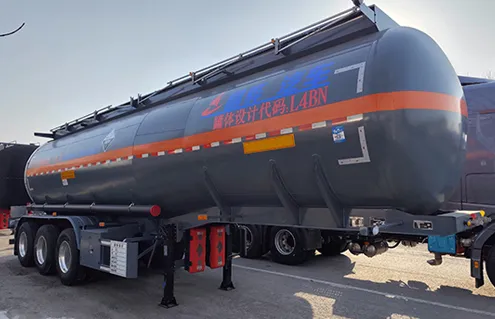
Steel tanker trailers are manufactured using high-strength carbon steel materials such as Q345R. Although steel has a relatively low material cost, its density is higher.
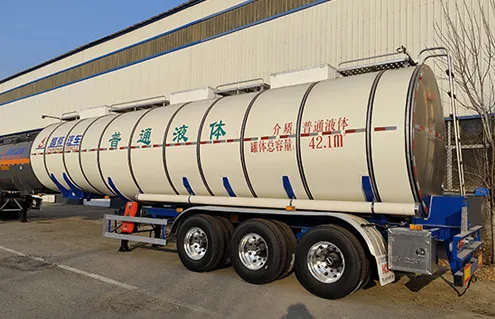
Taking a 45 m³ atmospheric liquid tanker as an example, the tare weight of a steel tank body is approximately 7.5–8 tons, while an aluminum alloy tanker trailer from HCSV with the same capacity weighs only around 6.5 tons.
This represents a weight reduction of approximately 13%–15%.
Under the 40-ton highway weight limit regulations, an aluminum alloy tank body can carry more than 1 additional ton of cargo per trip.
For transportation scenarios involving products such as refined oil and chemical raw materials that are charged based on cargo weight, the revenue generated per vehicle trip can be significantly improved.
The main disadvantage of steel tank bodies is corrosion.
When ordinary carbon steel transports water-containing materials or operates in coastal salt-spray environments, rust can easily develop on the inner surface.
This not only contaminates the transported liquid but may also block valves and pipelines. In many cases, large-scale anti-corrosion refurbishment is required after only several years of operation.
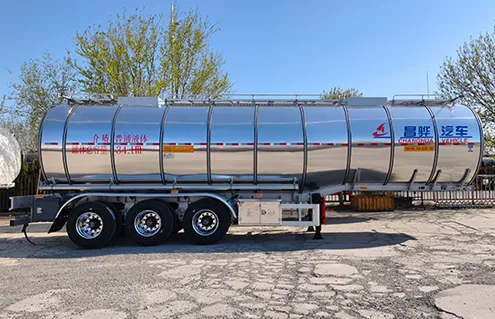
HCSV aluminum alloy tanker trailers use 5083-H11 marine-grade aluminum alloy plates, which provide natural oxidation and corrosion resistance.
A dense oxide film forms automatically on the surface, eliminating the need for frequent anti-corrosion coatings.
Under normal maintenance conditions, aluminum alloy tank bodies provide a longer service life. Even after long-term operation, the inner wall remains smooth, reducing the risk of rust contamination.
This makes aluminum alloy tanker trailers especially suitable for transporting food-grade liquids and high-purity chemical products.
For industries requiring reliable corrosion-resistant transportation solutions, an aluminum tanker trailer provides significant advantages in long-term operation.
From a structural safety perspective, aluminum alloy materials have better ductility than steel.
During collisions, aluminum alloy can absorb impact energy through plastic deformation, reducing the risk of tank rupture and leakage.
At the same time, the lighter weight of aluminum alloy tanker trailers lowers the vehicle's center of gravity, improving stability during high-speed driving and cornering while reducing braking distance.
However, it should be noted that aluminum alloy tank welding requires significantly higher manufacturing standards than steel tanks.
If welding processes are not properly controlled, stress corrosion cracking may occur around weld areas.
HCSV uses robotic automatic welding production lines and overall stress-relief heat treatment processes to ensure that tank weld strength is consistent with the base material.
All products undergo national special equipment inspection and testing.
The main advantage of steel tanker trailers is their lower initial purchase price.
For the same tank capacity, aluminum alloy tanker trailers generally cost 15%–20% more than steel models.
This is one of the main reasons why many individual transportation operators prefer stainless tank trailer.
However, comparing only the purchase price represents a short-term decision.
From a total lifecycle perspective, the operational cost advantages of aluminum alloy tanker trailers gradually offset the initial price difference.

Total Cost of Ownership (TCO) includes four major components:
Initial purchase cost
Fuel consumption cost
Maintenance cost
Residual value recovery
The following comparison is based on annual operation of 150,000 kilometers and a service life of 10 years.
Vehicle weight has a direct relationship with fuel consumption.
According to measured data, aluminum alloy tanker trailers reduce fuel consumption by:
8%–12% under empty-load conditions
5%–8% under full-load conditions
Based on a comprehensive fuel consumption rate of 35 liters per 100 kilometers and diesel price of 7 RMB/liter, an aluminum alloy tanker trailer can save approximately:
3,000–4,500 liters of fuel annually
21,000–31,500 RMB in fuel costs per year
Over a 10-year operating period, fuel savings alone can reach approximately 200,000–300,000 RMB.
In addition, reduced vehicle weight also decreases tire wear and extends brake pad service life.
Annual replacement costs for tires and wearing parts can be reduced by approximately 10%.
Steel tanker trailers generally require sandblasting, rust removal, and anti-corrosion repainting every 2–3 years.
Each treatment costs approximately 20,000–30,000 RMB.
In addition, annual inspections and repairs of internal corrosion, as well as replacement of valves and filters affected by rust particles, are required.
Over a 10-year period, the cumulative maintenance cost of steel tanker trailers is approximately 150,000–200,000 RMB.
Due to corrosion resistance, aluminum alloy tanker trailers only require routine inspections of sealing components and safety accessories, without large-scale anti-corrosion treatment.
HCSV aluminum alloy tanks use cathodic electrophoresis technology and water-based paint coating, providing long-lasting surface protection.
Over 10 years, maintenance costs are only around 40%–50% of steel models, saving approximately 80,000–100,000 RMB.
The value difference during scrap recycling is often overlooked.
Currently, aluminum recycling prices are approximately 15,000 RMB per ton, while scrap steel recycling prices are only around 2,000 RMB per ton.
The difference exceeds seven times.
For an aluminum alloy tank body weighing approximately 6.5 tons, the recycling value at the end of service life can reach around 90,000–100,000 RMB.
A steel tank body with the same capacity has a recycling value of only around 15,000–20,000 RMB.
The residual value difference can reach 70,000–80,000 RMB.
Although the initial purchase cost of aluminum alloy tanker trailers is approximately 80,000–100,000 RMB higher, the combined benefits of fuel savings, reduced maintenance costs, and higher residual value allow operators to recover the price difference within approximately 3–5 years.
After more than five years of operation, the TCO advantage of aluminum alloy tanker trailers continues to expand.
Over a 10-year lifecycle, the total cost of ownership can be 150,000–250,000 RMB lower than steel tanker trailers.

As a national high-tech enterprise and provincial-level specialized and innovative enterprise, HCSV operates complete production lines for both aluminum alloy and steel tanker trailers.
The company's products have passed ISO9001 quality management system certification and EU ADR hazardous goods transportation certification, and are widely exported to dozens of countries and regions worldwide.
In the aluminum alloy tanker trailer field, HCSV adopts a frameless self-supporting tank structure design with more uniform stress distribution.
Compared with traditional chassis-frame structures, this design reduces weight by an additional 15% and improves payload efficiency.
The tank body uses 5083 aluminum alloy plates and adopts an integrated forming process to reduce longitudinal welds and lower leakage risks.
The equipment is equipped with emergency shut-off valves, overflow protection devices, and electrostatic grounding systems.
These configurations comply with the GB 18564.1 standard for road transportation liquid hazardous goods tank vehicles.
In the steel tanker trailer field, HCSV uses Q345R pressure vessel steel, which is suitable for demanding applications such as high-temperature asphalt and corrosive liquids.
The company holds special equipment manufacturing licenses and pressure vessel manufacturing qualifications.
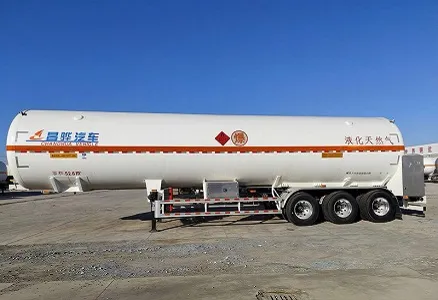
It can manufacture pressure tanker trailers for liquefied petroleum gas, liquid oxygen, liquid nitrogen, and other hazardous materials, meeting different chemical transportation requirements.
Equipment selection should be based on actual operating conditions.
For medium- and long-distance transportation with:
Annual mileage exceeding 120,000 km
Operating periods longer than 5 years
Aluminum alloy tanker trailers provide clear TCO advantages and are recommended.
For:
Short-distance transportation
Harsh operating environments such as mines and construction sites
Service periods shorter than 3 years
Steel tanker trailers provide better cost performance due to their lower initial investment.
With the continued development of the Belt and Road Initiative and the global transition toward greener logistics, lightweight and corrosion-resistant aluminum alloy tanker trailers have become an important direction for international exports.
HCSV follows the development philosophy of:
"Building first-class products, establishing the HCSV brand, and creating a century-long enterprise."
The company continues investing in intelligent manufacturing and technology development.
Through robotic welding, laser cutting, and automated coating production lines, HCSV provides high-quality tanker trailer products that comply with international standards such as ADR and DOT, helping transportation companies reduce costs, improve efficiency, and achieve sustainable development.