English
 français
 Español
 русский
 português
 العربية
 Türkçe
 tiếng việt
 Burmese
Phone:
+8603175985777
 Hebei Changhua Star Vehicle Co.,Ltd.
WHAT ARE YOU LOOKING FOR?
Hebei Changhua Star Vehicle Co.,Ltd.
As global long-distance transportation of hazardous chemicals and liquid cargo continues to move toward lightweight design, improved safety, and lower energy consumption, frameless self-supporting tanker trailers are becoming an increasingly popular choice in overseas markets, including countries along the Belt and Road Initiative, the Middle East's Gulf Cooperation Council (GCC) countries, Central Asia, and Southeast Asia.
With qualifications for both pressure vessel design and manufacturing, HCSV (Changhua) has extensive experience in tanker trailer structural research and development. This article provides a comprehensive performance comparison between frameless self-supporting tanker trailers and traditional framed tanker trailers, helping overseas customers select the most suitable vehicles based on their operating conditions while balancing transportation safety, payload efficiency, and long-term operating costs.
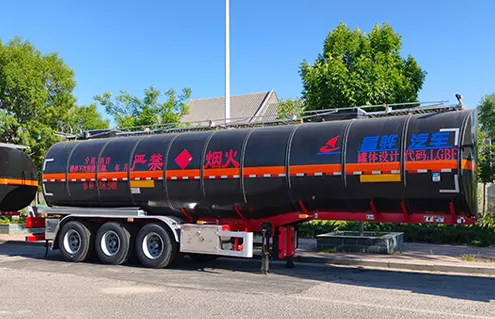
Traditional framed tanker trailers adopt a semi-load-bearing structure consisting of a longitudinal chassis frame and tank supports. Most of the vehicle load is carried by the longitudinal frame, while the tank serves as a container for the transported medium and is secured above the frame through supports and mounting plates. This structure is relatively simple to manufacture and has long been a mainstream solution for liquid transportation worldwide, making it suitable for heavy-duty operations under various road conditions.
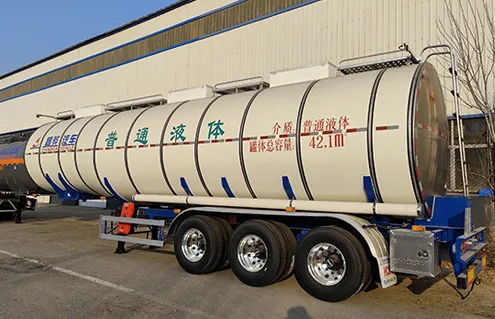
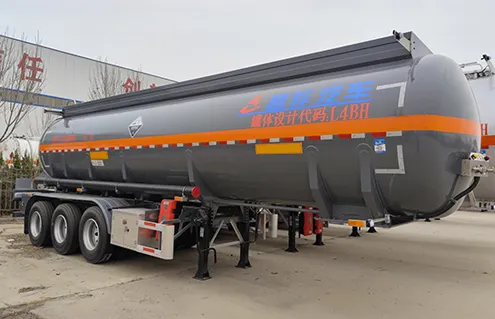
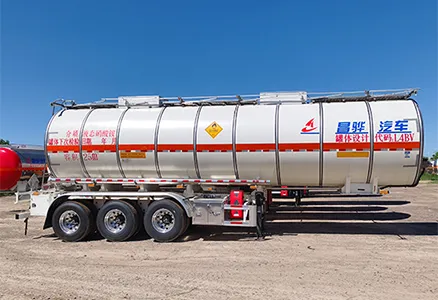
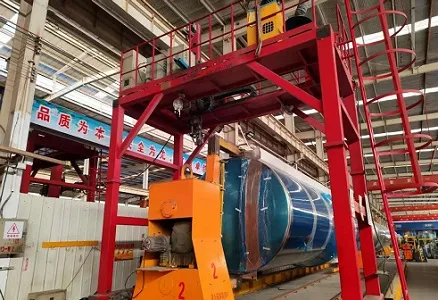
HCSV's frameless tanker trailers adopt a fully self-supporting tank design, eliminating the independent longitudinal chassis frame. The tank itself serves as the main load-bearing structure, with the tank shell, reinforcing rings, and anti-surge baffles working together to distribute cargo weight, road impacts, and torsional loads. This structure places extremely high requirements on welding quality, stress relief, and finite element analysis (FEA). HCSV uses an overall stress-relief heat treatment process, combined with materials such as 5083 aluminum alloy and Q345R high-strength carbon steel, to ensure tank stability and reliability under complex alternating loads.

Traditional framed tanker trailers have a relatively high curb weight because of the additional longitudinal beams, subframes, and support components. Under national vehicle weight regulations, this additional weight limits the effective payload capacity and increases fuel consumption.
The frameless self-supporting design eliminates the longitudinal frame, reducing the overall vehicle weight by approximately 300–500 kg. With the permitted gross vehicle weight remaining unchanged, this reduction increases the available payload capacity and reduces energy consumption per unit of cargo transported. For long-distance liquid transport operators in the Middle East and Southeast Asia, this can significantly improve revenue per trip and reduce carbon emissions over the long term, in line with the global trend toward green logistics.
In traditional framed tanker trailers, the tank is mounted above the longitudinal chassis frame, resulting in a relatively higher center of gravity. This increases the risk of rollover when driving around curves, in strong crosswinds, or on slippery roads. During operation, stress concentrations may also develop between the frame and tank supports, and prolonged vibration can lead to cracking of the support welds.
Frameless tanker trailers feature a lower tank position, significantly reducing the vehicle's center of gravity and improving resistance to rollover. Loads are distributed more evenly throughout the tank structure, helping to avoid localized stress concentrations. Under extreme operating conditions, such as large temperature variations in Central Asia's Gobi region, muddy roads in Indonesia's tropical rainforests, and salt-spray corrosion in coastal areas, the structure offers greater resistance to fatigue and deformation.
Traditional framed tanker trailers generally offer greater ground clearance, providing better passability on uneven dirt roads, unpaved mining routes, and other rough surfaces. They are suitable for short-distance, heavy-duty transportation and demanding outdoor construction environments. Frame and support components are also relatively easy to repair or replace, resulting in lower maintenance costs.
Frameless tanker trailers have a lower center of gravity but relatively less ground clearance. They are more suitable for long-distance transportation on paved roads and highways, including routes between petrochemical plants, ports, and cross-border highways used for hazardous chemical transportation. These are common operating environments for a chemical tanker trailer. However, prolonged and frequent operation on severely uneven off-road routes is not recommended.

Traditional framed tanker trailers benefit from mature manufacturing processes, simpler welding and assembly requirements, and lower initial purchase costs. Replacement parts are widely available through maintenance networks in different countries, and damaged components are relatively easy to repair. This makes them suitable for operators with limited budgets and frequent short-distance transportation requirements.
Frameless self-supporting tanker trailers require more complex design, welding, and heat treatment processes, resulting in higher production costs and a higher initial purchase price than traditional framed models. Maintenance also requires a certain level of technical expertise. Since the tank itself is a load-bearing component, unauthorized cutting, welding, or structural modifications are not permitted. However, thanks to their lightweight design and more uniform stress distribution, frameless tanker trailers can reduce tire wear and fuel consumption during compliant long-distance operations, delivering better overall economic returns throughout their service life.
Both types of tanker trailers can be equipped with thermal insulation, heating systems, and vacuum-insulated configurations. Depending on their specific design, they can transport ordinary liquids, petroleum products, chemical substances, and cryogenic liquefied gases. HCSV tanker trailers have obtained international certifications, including ISO and GCC certifications, and can be exported to markets such as Saudi Arabia, Oman, Kazakhstan, Uzbekistan, Tanzania, and Colombia.
Traditional framed tanker trailers: Preferred for short-distance transportation of general cargo and heavy-duty materials such as heavy oil and asphalt, including applications involving asphalt trailers.
Frameless self-supporting tanker trailers: Preferred for long-distance cross-border transportation of hazardous materials such as LNG, liquid oxygen, propylene, and methanol, including applications involving an LNG trailer.
1. Long-distance highway transportation, paved roads, and cross-border hazardous chemical transport
For operators seeking higher payload capacity, improved driving safety, and lower fuel consumption, HCSV recommends choosing frameless self-supporting tanker trailers. They are particularly suitable for cross-border logistics companies operating in the Middle East, Southeast Asia, and countries along the Belt and Road Initiative.
2. Short-distance transportation, unpaved mining or construction roads, and limited budgets
For operators requiring frequent field repairs or working under challenging off-road conditions, traditional framed tanker trailers remain a cost-effective solution.
Frameless self-supporting tanker trailers are not intended to completely replace traditional framed tanker trailers. Instead, the two designs represent different technical approaches suited to different applications. Traditional framed tanker trailers offer advantages in versatility, lower costs, and off-road capability, while frameless tanker trailers stand out for their lightweight construction, lower center of gravity, improved safety, and greater economic efficiency in long-distance transportation.
HCSV (Changhua) continues to improve tanker trailer structural technology, drawing on strict manufacturing standards and extensive experience in pressure vessel engineering to provide safe and reliable tank transportation equipment for liquid and hazardous chemical logistics customers worldwide. For detailed technical specifications, application-specific recommendations, and quotations for both tanker trailer types, please contact HCSV's overseas sales team.