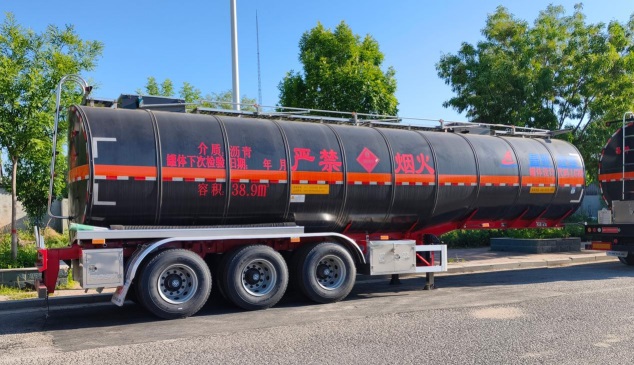
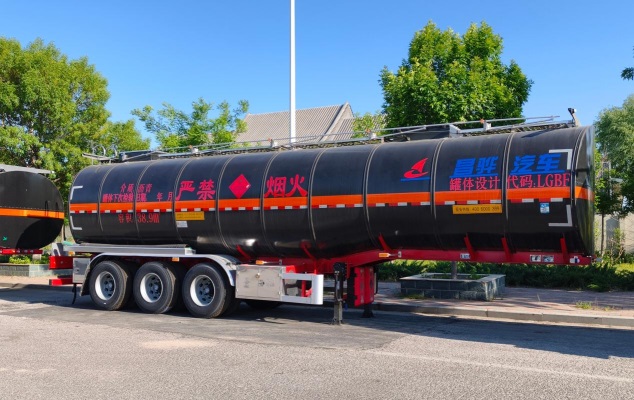
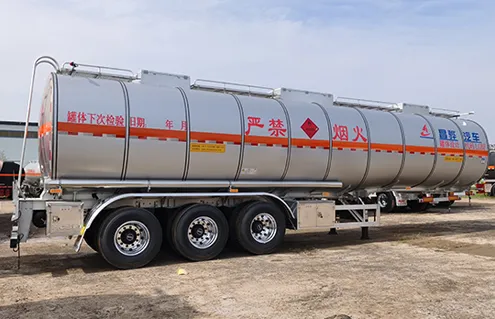
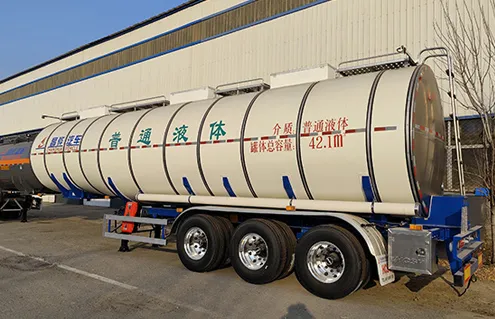
As global road construction and maintenance markets continue to expand, liquid asphalt transportation is facing increasingly demanding efficiency and cost-control requirements. Hebei Changhua Star Vehicle Co., Ltd. (HCSV) has officially introduced the HCH9406GRY39 flammable liquid tank semi-trailer. Developed around three common asphalt-transport challenges—unstable temperature control, inefficient loading and unloading, and residual material at the bottom of the tank—the new model uses targeted technologies to improve both operating efficiency and cost control, giving tank transport companies a measurable path to higher profitability.
Outdated Equipment Continues to Erode Fleet Profitability
Profitability in liquid asphalt transportation depends heavily on stable temperature control and fast vehicle turnaround. However, performance limitations in much of the equipment currently in service continue to reduce fleet margins. According to a 2025 survey cited by the Road Construction Machinery Branch of the China Highway and Transportation Society, more than 60% of asphalt tankers in domestic service have inadequate insulation or low discharge efficiency, resulting in estimated hidden losses of RMB 80,000 to RMB 120,000 per vehicle each year.
Temperature Deviations Can Cause Complete Cargo Loss
Liquid asphalt has a narrow working-temperature window and generally needs to arrive at the jobsite between 145°C and 165°C. Conventional tanks often have insufficient insulation thickness or inefficient structural designs, leading to temperature drops of more than 2°C per hour during transportation and as much as 3°C to 4°C per hour over long distances.
Once asphalt falls below the paving threshold, its viscosity rises sharply. It may become impossible to discharge and may also be rejected by the contractor because the material can no longer achieve the required compaction. In such cases, more than 30 metric tons of asphalt may be lost in a single load, creating losses of tens of thousands of yuan.
Slow Discharge Reduces Vehicle Turnaround
Loading and unloading efficiency directly affects the number of trips a vehicle can complete each day. Traditional asphalt tankers commonly experience a “fast at first, slow at the end” discharge pattern. Gravity flow is adequate when the tank is full, but as the liquid level falls, the asphalt at the bottom becomes more viscous and less mobile, sharply reducing discharge speed. A full discharge typically takes 40 to 60 minutes.
For a vehicle scheduled to complete three trips per day, an additional 20 minutes spent on each discharge can eliminate one transport assignment from the daily schedule, directly reducing fleet revenue.
Residual Asphalt Creates Long-Term Hidden Costs
High-viscosity asphalt readily adheres to the bottom and corners of the tank. Conventional tanks typically achieve a discharge rate of only 95% to 97%, leaving 0.9 to 1.5 metric tons behind from a 30-ton load. After cooling and hardening, the residue requires manual removal and may require additional diesel for dilution. Over time, this accumulated material loss becomes a major but easily overlooked operating cost.
Four Technical Upgrades Deliver Three Operational Benefits
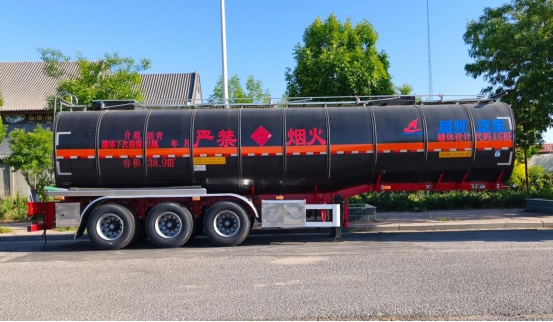
To address these industry-wide problems, the HCSV HCH9406GRY39 tank semi-trailer is systematically optimized in four areas: insulation, heating, discharge, and load-carrying structure. Together, these improvements reduce losses, increase efficiency, and maximize payload.
Three-Layer Composite Insulation for More Stable Temperature Control
Temperature control is the central requirement in asphalt transportation. The HCH9406GRY39 uses a three-layer composite insulation structure. High-density aluminum silicate fiber insulation, 80 to 100 mm thick, is installed between the outer shell and inner tank. Combined with a reflective thermal barrier and sealed construction, the system reduces heat loss through conduction, convection, and radiation.
Under standard test conditions with an ambient temperature of 25°C and an initial asphalt temperature of 160°C, the model limits temperature loss to less than 1°C per hour. It can maintain the required working temperature over long-distance journeys of up to 72 hours, substantially reducing fuel consumption associated with reheating during transit.
The tank also uses multiple axial temperature-measurement points to prevent localized overheating, aging, cooling, or solidification. This helps maintain an even temperature throughout the cargo and supports consistent discharge quality. The insulation layer uses integrated filling and moisture-resistant encapsulation to prevent water absorption, settling, and performance degradation, extending service life by more than 40% compared with conventional insulation processes.
Three Heating Options for Different Operating Environments
To suit the operating conditions of different depots and construction sites, the HCH9406GRY39 offers three optional heating systems: steam heating, burner heating, and solid-fuel heating. Fleet operators can select the configuration that best balances discharge speed, energy cost, and site compatibility.
Steam Heating. Provides even heating throughout the tank and reduces the risk of asphalt scorching or deterioration, helping protect material quality. Because no open flame is used, the system offers strong compliance and safety advantages during depot loading and unloading. Its simple and durable construction also supports low long-term maintenance costs.
Burner Heating. Delivers rapid temperature recovery, shortens unloading delays, and improves vehicle turnaround. The integrated fuel system allows operation at remote construction sites without external support equipment. Installation is straightforward, daily maintenance is simple, and drivers can operate the system with minimal training.
Solid-Fuel Heating. Can use lower-cost fuels such as coal or firewood, reducing heating expense per trip. The steady combustion process supports extended heat retention after a single fuel loading. Its simple, rugged structure is less prone to failure in dusty, cold, or otherwise demanding environments.
Large-Diameter Rapid-Discharge System Improves Speed and Reduces Loss
Discharge efficiency is critical to increasing vehicle utilization. The HCH9406GRY39 combines a DN200 large-diameter discharge valve with a sloped tank-bottom flow-guidance design, bottom heating, and an optimized internal flow path to improve both discharge speed and discharge completeness.
At an asphalt temperature of 160°C, the trailer can discharge its 38.9 m³ tank in less than 25 minutes—nearly 40% faster than a conventional asphalt tanker. A dual-slope tank bottom and low-positioned outlet minimize dead zones, achieving a discharge rate of at least 99% and limiting residual material to no more than 1%. This can reduce asphalt loss by approximately 300 kg per trip.
The discharge valve is pneumatically controlled, allowing operators to complete the unloading process from ground level without climbing onto the vehicle, significantly improving worksite safety.
Lightweight Load-Bearing Design Maximizes Legal Payload
Maximizing effective payload within the limits of GB 1589 is central to improving vehicle profitability. The HCH9406GRY39 has a total tank capacity of 38.9 m³, an effective volume of 37.12 m³, and a rated payload of up to 31.7 metric tons, placing it among the leading models in its class.
The tank is manufactured from high-quality steel plate designed for pressure-vessel applications. CAE simulation is used to optimize tank-wall thickness and reinforcement structures, reducing tare weight without compromising structural strength. The curb weight is as low as 8.3 metric tons, allowing more cargo to be carried at the same gross vehicle weight. The vehicle uses a 5,250 + 1,310 + 1,310 mm wheelbase, with a 24,000 kg load rating for the tri-axle group. This provides even load distribution, stable road performance, and more uniform tire wear.
Comprehensive Safety and Compliance for Hazardous-Liquid Transport
As a compliant flammable liquid tank semi-trailer, the HCH9406GRY39 is designed in accordance with applicable national standards for dangerous-goods transportation and is qualified for the legal transport of asphalt and other flammable liquid media.
The trailer is equipped as standard with an EBS electronic braking system for more stable braking under heavy loads and improved safety on wet or slippery roads. The tank is designed and manufactured to relevant standards and undergoes both hydrostatic and airtightness testing to minimize leakage risk. It is also fitted with a complete set of safety accessories, including an emergency shut-off valve, safety valve, and pressure-vacuum vent valve, to meet hazardous-material transport requirements.
Equipment Upgrades Become a Key Competitive Advantage
The asphalt transportation industry is moving from market expansion to competition within an established fleet base. Competing solely by lowering freight rates is no longer sustainable. The factors that increasingly separate operators are the efficiency improvements and cost-control capabilities created by better equipment.
An HCSV representative stated that the HCH9406GRY39 was developed around real asphalt-transport operating conditions and is intended to deliver practical, measurable cost reductions and efficiency gains. With more stable temperature control, faster loading and unloading, lower residual material, and greater legal payload, the model helps transport companies generate higher profit from the same volume of business and build a stronger equipment advantage in a competitive market.
For transport operators considering fleet renewal or seeking to improve competitiveness, the HCH9406GRY39 represents more than an equipment purchase—it is a strategic investment in long-term profitability. For detailed specifications, customization options, and quotation information, customers can visit the official HCSV website or contact the sales team.
About Hebei Changhua Star Vehicle Co., Ltd.
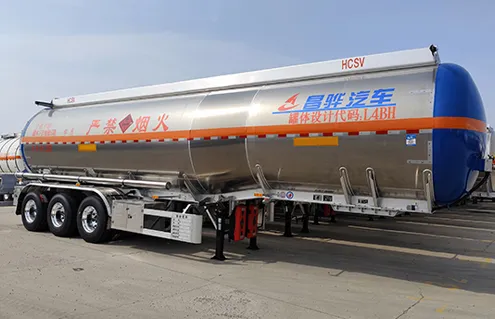
Hebei Changhua Star Vehicle Co., Ltd. is a professional Chinese manufacturer of tank transport equipment. The company develops, manufactures, and sells special-purpose vehicles for hazardous-material transportation, cryogenic and other specialized transport applications, and powder and granular material logistics. Its products are supplied across multiple provinces and cities in China and exported to markets worldwide. HCSV uses customers’ operating challenges as the starting point for product development and is committed to providing efficient, safe, and compliant special-purpose vehicle solutions for global logistics and transport customers.
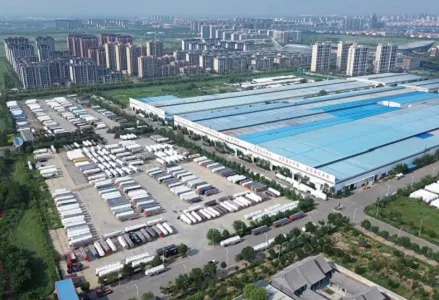
 Hebei Changhua Star Vehicle Co.,Ltd.