An 8000 gallon tanker trailer provides approximately 30,283 liters (30.3 m³) of nominal tank volume when calculated in U.S. gallons. It is a practical size for fuel distribution, industrial water transport, and selected chemical applications, but 8,000 gallons of tank space does not mean every liquid can be loaded to the full 8,000-gallon volume.
Actual payload is determined by liquid density, trailer tare weight, axle configuration, permitted gross vehicle weight, filling requirements, and local transport regulations. An 8,000-gallon tank filled with gasoline, for example, places substantially less cargo weight on the chassis than the same tank filled with water or a high-density chemical. Industry sources consequently treat product density and legal weight—not physical tank volume alone—as key capacity constraints.
For buyers, the right specification should therefore combine tank capacity, payload requirement, cargo type, axle layout, compartment design, material, and unloading system.
How Much Can an 8000 Gallon Tanker Trailer Carry?
An 8,000-U.S.-gallon tank has the following nominal capacity:
| Unit | Approximate Capacity |
|---|
| U.S. gallons | 8,000 gal |
| Liters | 30,283 L |
| Cubic meters | 30.28 m³ |
| Imperial gallons | 6,661 gal |
The important distinction is between volume capacity and cargo payload.
Cargo weight can be estimated using:
Cargo weight = liquid volume × liquid density
As a practical comparison:
| Liquid | Approx. Density | Weight of 8,000 U.S. gal / 30,283 L |
|---|
| Gasoline | ~0.74 kg/L | ~22.4 tonnes |
| Diesel | ~0.84 kg/L | ~25.4 tonnes |
| Water | ~1.00 kg/L | ~30.3 tonnes |
| Chemical at 1.30 kg/L | 1.30 kg/L | ~39.4 tonnes |
These figures illustrate why the same 8000 gallon tanker trailer cannot necessarily carry a full-volume load of every product. Gasoline is relatively light, while water and many industrial chemicals reach weight limits much sooner. Published industry guidance similarly notes that tanker sizing must account for product density and legal weight.
Trailer tare weight, tractor weight, driver, fuel, accessories and cargo all contribute to gross combination weight. Axle-group loading must also remain legal.
In the United States, for example, federal Interstate limits are generally 20,000 lb for a single axle, 34,000 lb for a tandem axle group and 80,000 lb gross vehicle weight, with the Federal Bridge Formula potentially producing a lower allowable figure depending on axle spacing. Other markets use different rules.
An 8,000-gallon quotation should therefore always be checked against the intended cargo and destination country's regulations.
Typical Applications for an 8000 Gallon Tanker Trailer
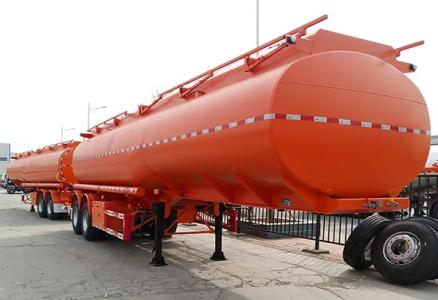
The 8,000-gallon size sits in a useful range for commercial liquid transportation. Published tanker references show 8,000 gallons appearing in petroleum, chemical and general liquid transport configurations.
Common applications include:
Gasoline and diesel distribution
Fuel terminal-to-station delivery
Mining and construction-site fuel supply
Industrial water transport
Road construction and dust-control water supply
Agricultural water transportation
Non-potable municipal water delivery
Selected acids and chemical solutions
Industrial liquid raw-material transportation
For petroleum distribution, an 8000 gallon tanker trailer can be particularly useful when fleets need sufficient delivery volume without moving to the largest possible tanker configuration.
A fuel tank trailer may also be divided into several compartments. This allows one trip to carry different fuel grades or divide deliveries among multiple customers rather than dedicating the entire tank to one product. Multi-compartment petroleum trailers are widely used for this reason.
Fuel, Water and Chemical Tank Configurations
Although the nominal volume can remain 8,000 gallons, the correct construction changes significantly according to the liquid.
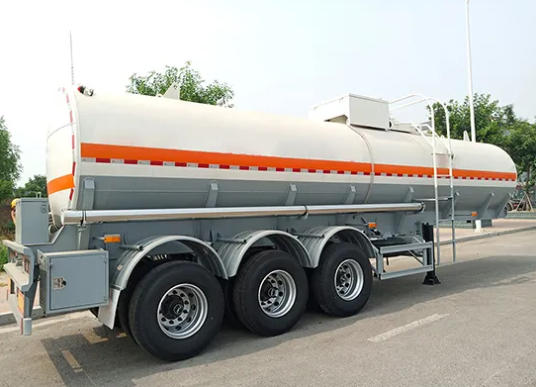
8000 Gallon Fuel Tank Trailer
For gasoline, diesel and other petroleum products, buyers should consider:
Single- or multi-compartment tank design
Bottom loading compatibility
Emergency shut-off or bottom valves
Vapor recovery requirements
Pump or gravity discharge
Hose and pipeline arrangement
Manhole and overfill-protection configuration
Anti-static and grounding provisions
Applicable dangerous-goods regulations
Fuel tankers frequently use multiple compartments when several petroleum products must be delivered on one route. Tanker sources describe configurations ranging from one to several compartments depending on product and operating requirements.
For high-frequency fuel distribution, the unloading system deserves as much attention as tank volume. A well-specified fuel tank trailer should match the customer's terminal loading method and receiving-site discharge requirements.
8000 Gallon Water Tank Semi Trailer
An 8,000-gallon water tank semi trailer provides approximately 30,283 liters of physical volume, but a full water load weighs about 30.3 tonnes before the trailer and tractor are added.
For this reason, buyers should verify legal payload before selecting a full 8,000-gallon operating volume.
Typical water tanker options can include:
Rear, side or bottom discharge outlets
Water pump
Front, rear or side spray system
Hose reels
Internal baffles
Top filling connections
Manholes and ladders
Construction and mining fleets may prioritize powerful pumps and spraying systems, while general bulk-water operators may prefer simpler high-flow loading and discharge arrangements.
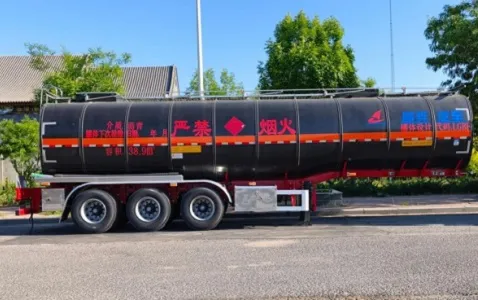
8000 Gallon Chemical Tanker
Chemical transportation requires more product-specific engineering.
Before specifying the tank, the manufacturer should know the exact chemical name, concentration, density, operating temperature and corrosion characteristics.
An 8,000-gallon chemical tanker may require stainless steel, specialized valves, compatible seals, heating or insulation systems, and a discharge arrangement suited to the product. Commercial listings confirm that 8,000-gallon stainless-steel chemical tanker configurations are in practical use.
For high-density chemicals, weight limitations can prevent the operator from using the full nominal tank volume. Capacity should be calculated from legal payload rather than assuming that 30,283 liters can always be loaded.
Axles, Compartments and Tank Material Options
Customization determines whether an 8,000-gallon tanker performs efficiently in its intended market.
Three-Axle or Four-Axle Configuration
Three-axle tanker trailers are common for commercial tanker transport and can offer a good balance of tare weight, load distribution and operating cost.
A four-axle configuration may be considered where higher axle capacity or different regional road regulations make additional load distribution advantageous. Market examples of 8,000-gallon four-axle tanker configurations are available, but adding an axle does not automatically mean the operator can carry more cargo; local gross-weight and axle-group regulations remain controlling.
Single or Multiple Compartments
An 8,000-gallon tank can be designed as:
A single compartment suits bulk transport of one product. Multi-compartment construction is often more valuable for petroleum distribution because different fuels or delivery quantities can be separated.
The compartment plan should be established before production because it influences internal structure, piping, valves, discharge operation and weight distribution.
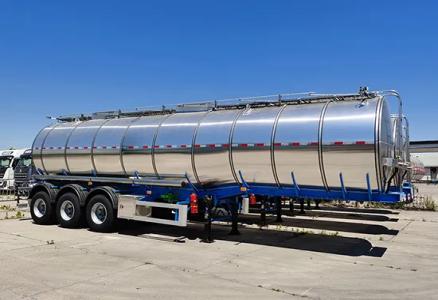
Carbon Steel, Stainless Steel or Aluminum
Carbon steel is widely selected when durability and purchase cost are primary considerations.
Stainless steel is typically specified where corrosion resistance, product purity or chemical compatibility requires it.
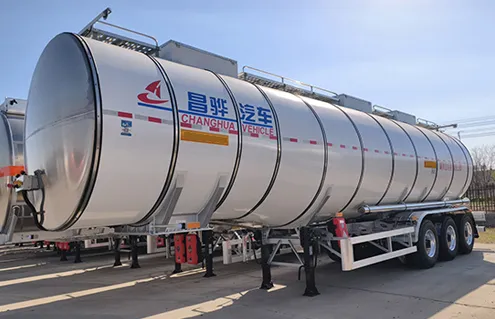
Aluminum can reduce tanker tare weight, which may improve available payload for fuel transport. HCSV's tanker guidance notes the use of aluminum for petroleum transportation where reducing vehicle weight is advantageous.
Material should therefore be chosen according to cargo compatibility and lifecycle economics rather than purchase price alone.
What Affects the Price?
There is no reliable universal price for an 8000 gallon tanker trailer because two trailers with the same nominal capacity may have very different specifications.
The main price factors include:
Tank material. Stainless steel and aluminum normally require different manufacturing costs from standard carbon-steel construction.
Number of axles. Three-axle and four-axle configurations differ in chassis, suspension, braking and running-gear requirements.
Compartments. Adding compartments requires additional bulkheads, valves, piping and manufacturing work.
Tank thickness and design standard. Cargo properties, operating pressure and regulatory requirements influence the engineering specification.
Discharge equipment. Pumps, meters, hose reels, bottom-loading systems and specialized valves increase both functionality and cost.
Suspension and axle brand. Mechanical or air suspension and different axle, brake and tire specifications affect the final quotation.
Safety equipment and certification. Petroleum and chemical trailers may need cargo-specific equipment and certification according to the destination market.
Instead of requesting only “the price of an 8,000-gallon tanker,” buyers will receive a more accurate quotation by providing cargo type, density, destination country, axle requirement, tank material, compartments and discharge method.
FAQs About 8000 Gallon Tanker Trailers
How many liters are in an 8000 gallon tanker trailer?
8,000 U.S. gallons is approximately 30,283 liters, or 30.28 cubic meters. Buyers should specify U.S. gallons when requesting quotations because Imperial gallons use a different conversion.
How much does 8000 gallons of water weigh?
8,000 U.S. gallons of water is approximately 30,283 liters and therefore weighs roughly 30.3 metric tonnes, depending slightly on temperature. The complete vehicle weight will be substantially higher after adding the tanker, tractor, fuel and equipment.
Can an 8000 gallon tanker carry both gasoline and diesel?
Yes, when the tanker is engineered with separate compartments and the applicable regulations allow the intended products to be transported in that configuration. Multi-compartment fuel tankers are commonly used to separate different petroleum products.
Is a three-axle or four-axle tanker better?
Neither is universally better. Three axles can provide a lower-tare and cost-effective configuration, while four axles may improve weight distribution in markets where regulations support that arrangement. The decision should be based on legal axle loads, tractor configuration, road conditions and required payload.
Can an 8000 gallon tanker trailer be customized?
Yes. Typical customization can include three or four axles, single or multiple compartments, carbon steel, stainless steel or aluminum tanks, mechanical or air suspension, pumps, bottom valves, hose reels, meters, loading systems and specialized discharge arrangements. Examples across the tanker market show 8,000-gallon units offered with multiple compartments and different axle configurations.
For HCSV customers, the most effective approach is to specify the cargo, density, required payload, destination country, number of compartments and loading/unloading process before finalizing the tanker design.
An 8000 gallon tanker trailer is not simply a 30,283-liter container on wheels. When the tank material, axle layout, compartments and discharge system are engineered around the actual cargo and local regulations, it becomes a more efficient transport asset—whether the requirement is a fuel tank trailer, a water tank semi trailer, or a customized tanker for industrial chemical liquids.

 Hebei Changhua Star Vehicle Co.,Ltd.