Tanker trailer capacity is usually stated in gallons, liters, or cubic meters (m³), but the number printed on a specification sheet is not necessarily the amount of liquid the trailer can legally carry on the road. A 40 m³ tank equals 40,000 liters or approximately 10,567 U.S. gallons, yet its actual payload depends on cargo density, safe filling limits, trailer tare weight, axle loading, and local gross vehicle weight regulations.
For buyers, the most useful rule is:
Actual loadable volume = the lower of the safe usable tank volume and the weight-limited cargo volume.
This distinction is especially important when specifying a tank trailer for fuel, water, chemicals, or food-grade liquids.
How Is Tanker Trailer Capacity Measured?
Manufacturers commonly express tanker capacity in three units:
Liters (L): widely used in Asia, Europe, Africa, the Middle East, and many other international markets.
Cubic meters (m³): frequently used in engineering drawings and tanker specifications.
Gallons: common in the United States and several other markets.
One cubic meter equals exactly 1,000 liters. NIST defines the liter as a cubic decimeter and confirms that 1 m³ equals 1,000 L.
For tanker calculations:
Always confirm whether a quotation refers to U.S. gallons or Imperial gallons. A 10,000-gallon specification can differ significantly depending on which gallon standard is being used.
Nominal Capacity vs. Actual Loading Capacity
This is one of the most important points when comparing tanker specifications.
Nominal tank capacity generally describes the designed or geometric volume of the tank. Usable, valid, or working capacity describes the volume available under the manufacturer's design conditions. The amount that can actually be transported may be lower again because of weight limits and cargo-specific filling requirements.
For example, a tanker may have a nominal volume of 40,000 liters, but that does not automatically mean operators should load exactly 40,000 liters of every product.
Actual loading must account for:
Required expansion or vapor space where applicable.
Product temperature and thermal expansion.
Cargo density.
Maximum permitted gross combination weight.
Individual axle and axle-group limits.
Tank compartment configuration.
Cargo-specific transport regulations.
For hazardous products in particular, the nominal tank volume should never be treated as a loading instruction. The permitted filling ratio must follow the applicable tank design code, transport regulations, and product properties.
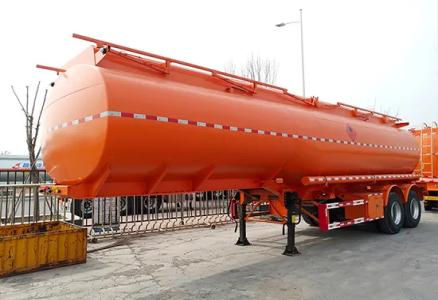
Common Capacities in Gallons, Liters and Cubic Meters
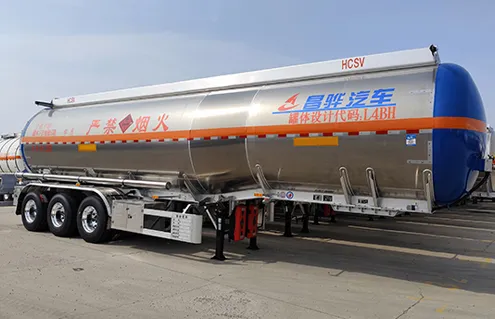
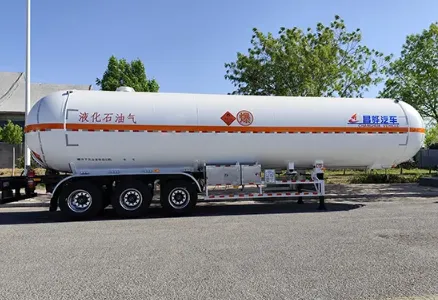
Highway tanker trailers are manufactured in many sizes. HCSV's fuel tanker range, for example, includes configurable volume and compartment options, while its industry guidance identifies approximately 3,000 to 12,000 gallons as a common commercial range for fuel transportation.
The following table provides quick conversions. Figures use U.S. gallons.
| Capacity (m³) | Capacity (Liters) | Approx. U.S. Gallons |
|---|
| 20 m³ | 20,000 L | 5,283 gal |
| 25 m³ | 25,000 L | 6,604 gal |
| 30 m³ | 30,000 L | 7,925 gal |
| 35 m³ | 35,000 L | 9,246 gal |
| 40 m³ | 40,000 L | 10,567 gal |
| 45 m³ | 45,000 L | 11,888 gal |
| 50 m³ | 50,000 L | 13,209 gal |
| 60 m³ | 60,000 L | 15,850 gal |
A buyer asking for a 40,000-liter fuel tank trailer, therefore, is specifying roughly a 40 m³ or 10,567-U.S.-gallon unit.
Capacity should still be considered together with the number of compartments. A multi-compartment fuel tank trailer may transport gasoline, diesel, or different fuel grades on the same delivery route. HCSV configurations, for example, can be produced with multiple compartments according to operating requirements.
How Cargo Density Affects Usable Capacity
Liquid density converts volume into weight, which is why two identical 40 m³ tanker trailers can have very different legal loading volumes.
The basic calculation is:
Cargo mass (kg) = Volume (L) × Density (kg/L)
Or, when determining the maximum volume allowed by available payload:
Maximum volume (L) = Available payload (kg) ÷ Liquid density (kg/L)
Consider a vehicle combination with 26,000 kg of available legal cargo payload after accounting for the tractor, trailer, fuel, driver, equipment, and other tare weight.
At an approximate density of 0.75 kg/L, gasoline would reach the weight limit at about:
26,000 ÷ 0.75 = 34,667 liters
For diesel at approximately 0.84 kg/L:
26,000 ÷ 0.84 = 30,952 liters
For water at approximately 1.00 kg/L:
26,000 ÷ 1.00 = 26,000 liters
A dense chemical at 1.50 kg/L would reach the same payload weight at only:
26,000 ÷ 1.50 = 17,333 liters
This is why ordering the largest possible tank is not always economically sensible. Liquid densities vary substantially between petroleum products, water, oils, and industrial chemicals.
A high-volume tank is most valuable when the cargo is light enough—and the road regulations permissive enough—to use that volume.
Choosing Capacity for Fuel, Water, Chemicals and Food Liquids
The correct tank trailer specification starts with the cargo, not with a target number of liters.
The following ranges are practical planning references rather than universal legal recommendations. Actual capacity must be calculated for the intended tractor, tanker tare weight, route, temperature, product specification, and local regulations.
| Medium | Typical Approx. Density | Practical Capacity Direction |
|---|
| Gasoline | 0.72–0.76 kg/L | 35–50 m³ where regulations permit |
| Diesel | 0.82–0.85 kg/L | 30–45 m³ |
| Edible oil | 0.91–0.93 kg/L | 28–40 m³ |
| Water | ~1.00 kg/L | 25–35 m³ |
| Milk | ~1.03 kg/L | 25–33 m³ |
| Medium-density chemicals | 1.10–1.40 kg/L | Often 20–30 m³ |
| High-density chemicals | 1.40 kg/L and above | Usually requires payload-led sizing |
Density varies with product grade, concentration, and temperature; use the actual product specification when designing the trailer.
Fuel Tank Trailer Capacity
Fuel transportation usually benefits from relatively large tank volumes because gasoline and diesel are lighter than water.
However, gasoline and diesel should not automatically be assigned the same load volume. Diesel is generally denser, so a combination that can legally transport a certain volume of gasoline may reach its gross weight limit earlier when carrying diesel.
Multi-compartment configurations also matter for fuel distribution. Buyers supplying service stations may prioritize compartment flexibility, while depot-to-depot transport may favor larger individual compartments and maximum payload efficiency.
Water Tanker Capacity
Water simplifies compatibility considerations but creates a significant weight constraint because its density is approximately 1 kg/L.
A 40,000-liter water load alone weighs roughly 40 metric tonnes, before adding the weight of the tractor and tanker. In many jurisdictions, therefore, a 40 m³ physical tank cannot legally be used at its full geometric volume for highway water transport.
Chemical Tanker Capacity
Chemical tanker sizing should be based on the exact product.
Two chemicals transported in similar-looking stainless steel tanks can have dramatically different densities, corrosion requirements, lining specifications, and permitted filling ratios. For dense acids and other heavy liquids, payload weight can become the limiting factor well before the tank reaches its volumetric capacity.
Material compatibility—carbon steel, stainless steel, aluminum, or lined construction—must be determined alongside capacity.
Food-Grade Liquid Capacity
Milk, edible oil, juice, glucose syrup, and other food liquids require additional attention to sanitary construction, cleaning, insulation, and contamination control.
Density remains important. A food-grade tanker intended primarily for edible oil may use a different optimum capacity from one designed for milk or high-density syrup.
Axle Configuration, Legal Weight and Capacity
Axle configuration is one of the main reasons a large tank does not automatically equal a large legal payload.
The important figure is not simply the number of axles. It is how total vehicle weight is distributed across the steer axle, tractor drive axles, kingpin, and trailer axle group.
A three-axle tanker may offer better load distribution than a two-axle design in markets where regulations allow it, while four-axle and specialized configurations may be appropriate for higher gross-weight jurisdictions. More axles, however, do not automatically authorize additional payload.
For reference, U.S. federal Interstate rules generally limit vehicles to 20,000 lb on a single axle, 34,000 lb on a tandem axle group, and 80,000 lb gross vehicle weight, subject to the Federal Bridge Formula. Axle spacing can therefore affect legal weight even when individual axle ratings appear adequate.
Other countries apply different gross vehicle, axle, dimensional, and permit rules.
Before ordering a tanker, a professional manufacturer should therefore know:
Destination country and operating region
Intended cargo and density
Desired payload per trip
Tractor configuration and approximate tare weight
Required number of tanker axles
Local axle-load and gross-weight limits
Required tank material
Number and volume of compartments
Loading and unloading method
This information allows the manufacturer to engineer a tank trailer around usable payload rather than simply supplying the largest tank that will fit on the chassis.
FAQs About Tanker Trailer Capacity
How many gallons does a tanker trailer hold?
There is no single standard capacity. Fuel tanker trailers commonly range from several thousand gallons to around 12,000 gallons in many conventional applications, while larger or specialized configurations are available for markets with different vehicle weight rules. HCSV's fuel tanker guidance identifies 3,000–12,000 gallons as a common commercial range.
How many liters is a 10,000-gallon tanker?
If the specification means 10,000 U.S. gallons, the capacity is approximately 37,854 liters, or 37.85 m³.
If it means 10,000 Imperial gallons, the volume is approximately 45,461 liters, which demonstrates why buyers should always specify the gallon standard.
How many gallons are in a 40 m³ tanker trailer?
A 40 m³ tanker equals:
40 m³ = 40,000 liters ≈ 10,567 U.S. gallons.
This describes volume only; it does not guarantee that 40,000 liters of the intended cargo can legally be transported.
Why can't every tanker trailer be filled to 100%?
Because safe and legal loading depends on more than geometric volume. Thermal expansion, vapor or outage requirements, cargo characteristics, tank regulations, compartment design, gross weight, and axle loading can all restrict the permitted quantity.
The allowable fill level should always follow the applicable product and transport requirements rather than a universal percentage.
Does tank size or payload capacity matter more?
For commercial operation, usable legal payload matters more than nominal tank size.
A larger tank can provide flexibility for low-density products, but it provides little economic benefit if axle or gross vehicle weight limits prevent operators from using the additional volume.
 Hebei Changhua Star Vehicle Co.,Ltd.